
The Coptic Legacy
Egypt’s Final Script
The final phase of Pharaonic expression, bridging the ancient world of the Pharaohs with the Christian era. A linguistic treasure preserving the voice of the pyramid builders.
The Linguistic Continuum
Old Egyptian
c. 2650 – 2135 BCEThe language of the Pyramid Texts.
Middle Egyptian
c. 2135 – 1785 BCEThe classical language of literature.
Late Egyptian
c. 1550 – 700 BCEThe vernacular of the New Kingdom.
Demotic
c. 700 BCE – 400 CEAdministrative and literary script.
Coptic
c. 300 CE – 17th CenturyThe final phase, using Greek & Demotic signs.
The Coptic Alphabet
A beautiful fusion of the Greek alphabet and Demotic signs. 32 letters that unlocked the secrets of Ancient Egypt.
The Seven Survivors
The Greek alphabet lacked sounds for uniquely Egyptian phonemes. These 7 letters were borrowed from the Demotic script—the people’s script—to complete the Coptic alphabet.
Dialect Geography
Coptic was not a monolithic entity; it was a cluster of dialects reflecting the elongated geography of the Nile Valley.
- Sahidic (South):The standard literary dialect of the Upper Nile and Gnostic texts.
- Bohairic (North):Native to the Delta, it became the liturgical language of the Church.
- Fayyumic (West):Spoken in the oasis, known for its distinct "lambdacism" (L for R).
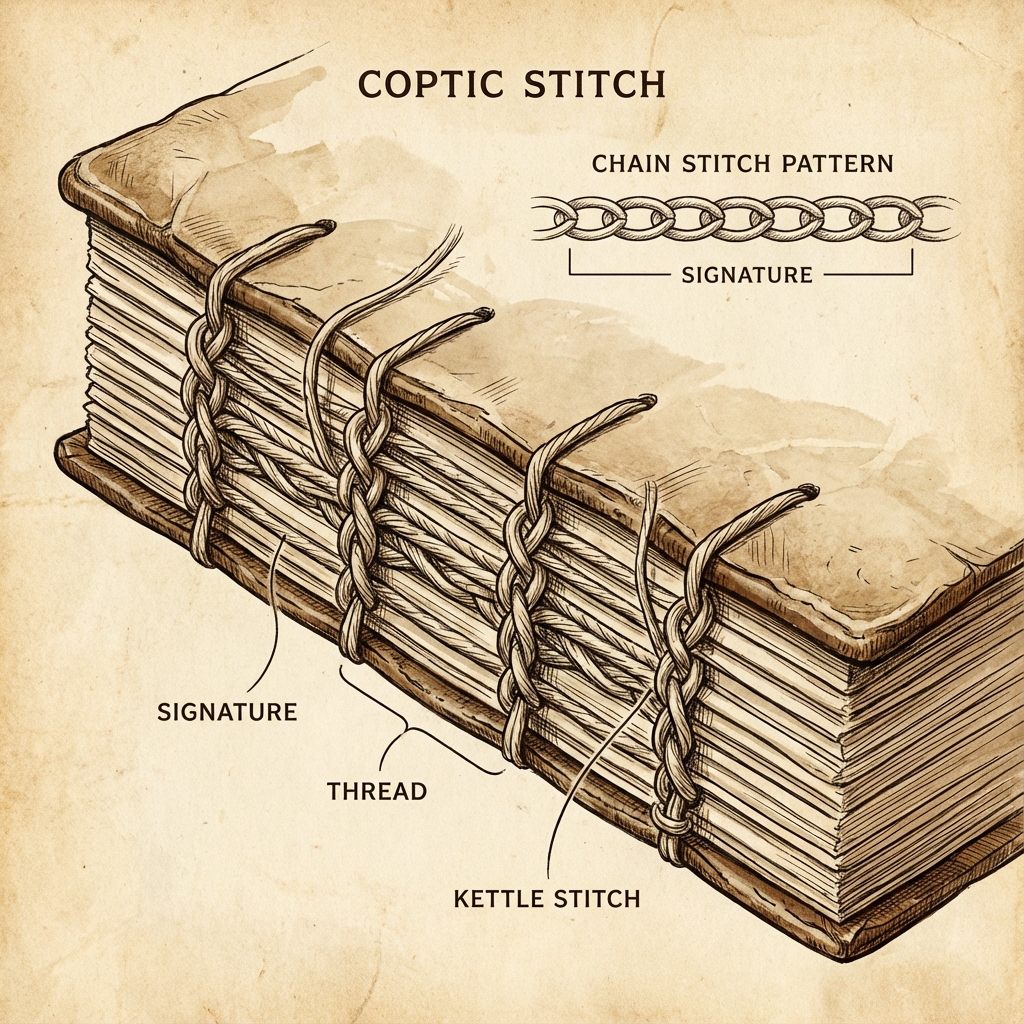
The Coptic Stitch
The Copts revolutionized bookmaking by popularizing the codex. Their unique binding technique, the "Coptic Stitch," uses a chain-link sewing method that allows the book to open a full 180 degrees without damaging the spine. This visible, exposed spine is a hallmark of Coptic bookbinding and influenced Western medieval manuscripts.
The Key to the Past
"Without the Coptic language preserving the sounds and words of ancient Egypt, the hieroglyphs might never have been deciphered. Coptic was the true Rosetta Stone of the mind."